Previous Page | Next Page | Main Noa Page
[Page 98]
1901 U.S.S. Mariveles
[i]
, On the Ways, Cavite, P.I.
June 17 Measurements for Displacement.
L.W.L. Six feet above and parallel to keel.
The original measurements were made by stretching four taut ropes (from poles laid horizontally on the main deck) to the ground. These vertical lines were eight feet from the middle of the ship, and formed a plane parallel to the longitudinal midship section. I found by plumb lines that the ship was on an even keel, so that, by stretching horizontal lines along the vertical ones at intervals of one foot the above measurements were obtained.
[Page 103]
June 17 Navy Yard workmen removed our starboard screw, used it for dimensions to mold the new port screw, and replaced it. We received a student’s lamp and other articles on an open purchase requisition.
18 Ensigns Farrant and Constein, and 2d Lieut. Pritchett, U.S.M.C. reported on board for temporary duty on a Summary Court Martial. Workmen scraped the ships bottom.
19 A Board of Inquiry was held to inquire into the loss of our propeller and tail shaft. Comd’r J.C. Fremont was President. Lt. Comd’r Walling was a member. The Board questioned Ensign Leahy, two of the machinists and myself, as to the circumstances of our grounding near Cebu. The evidence was that the stern was not near any obstruction, and that the damage had been done by underwater steps at the dock at the Cavite Naval Station.
Ensign Falconer reported on board as president of a S.C.M. of which the officers that reported yesterday were members, Ensign Constein being recorder. Edward Johnson, Oiler, was tried for disobeying an order. His sentence was one month’s confinement and to lose one month’s pay.
20. The Commanding Officer of the Mariveles, Ensign W,D, Leahy, read his orders, before the crew at quarters, detaching him from command. Ensign W.F. Farrant took command of the ship. Leahy was ordered to the Glacier soon to go to Australia. Farrant had commanded the U.S.S. Sardoqui, 42 tons, the preceding seven months.
21 Navy Yard force painted the ship’s bottom.
22 We were launched off the ways and the tug Balanga towed us to buoy No. 2 where we tied up.
[Page 105]
June 23 The U.S.Ships Yorktown, Castive and Wompatuck left the harbor. We had quarters and inspection at 9:30.
24. Workmen came off from the Navy Yard to work in the engine department, scraping and readjusting the setting of the values.
27 Went walking among the villages beyond Cavite.
28. The Kentucky came in and anchored. Drilled the crew at general quarters, fire and abandon ship drills.
29 At 8 p.m. the U.S.S. Manila saluted the Kentucky with 13 guns, and was saluted in turn with 7. The U.S.S. General Alava came in. We painted ship. The bottom paint turned brown above the water, and it was necessary to paint it red again.
30. The U.S.S. Zafiro came in, and the Piscataqua and Sardoqui left the Bay.
July 1 While sailing in the second cutter the sprit dropped out of the sail. The current was so strong that the boat with its reduced sail could not make headway against it, and when we resorted to oars, progress was so slow that the sprit drifted away from the fish weir and was lost before we could reach it.
The Vicksburg came into port.
2. The U.S.S. Urdaneta came in from Subig Bay.
[ii]
3. The Nashville and Albany left port. The Manila and Vicksburg moved close into Manila.
4 Full dressed ship, from 8 a.m. to 3 p.m. when ships were undressed by order from the Flagship on account of heavy breeze. At noon the saluting ships in port fired twenty-one guns. Major General MacArthur turned over the Civil Government of the Philippines the Governor Taft and the Military Establishment to Major General Chaffee.
[Page 106]
July 5. Drew the stores on Engineering requisition. Overhauled, inspected and blacked down both chain cables — white leading the shackle pins.
7. Sailed to Bacoor in first cutter, and, sending the boat back walked around to Cavite. By the road the distance is twenty miles. It being to late in the afternoon to walk this distance, it was necessary to follow the shore line. To swim the Imus river, and wade through several miles of marshy land. A long distance was cut of[f] near the head of Bacoor Bay by wading across amidst the fish weirs.
10. Received on board an old dinghy for side cleaning and rough work.
11. The Vicksburg went on the Ways at Cañacao.
14. Visited the Vicksburg on the ways. She had been damaged by grounding--scraping off some copper on the port bow. In spite of her copper sheathing the Vicksburg had a quantity of fouling adhering to her bottom, thick enough to necessitate being scraped off.
20. Our Chinese cook Ah Sing deserted. He went ashore to market in the morning, sent back his basket of provisions by the boat, saying that he wanted permission to stay ashore awhile.. He had previously sent all his clothes ashore, but took nothing that did not belong to him, and with Chinese peculiarity provided for breakfast before leaving.
25. The Don Juan de Austria and the Vicksburg left port. The Kentucky went out for target practise and returned at night. Drilled the crew at General Quarters and Abandon ship.
August 2. The Typhoon Signal #2, signifying that a typhoon was passing to the northward was hoisted in the Navy Yard. The wind blew a moderate gale at about 3 p.m., and changed suddenly to a light breeze. The barometer went down to 753 millimeters.
[Page 107]
Aug. 4. While trying to fix the Students’ Lamp to make it burn better, the oil in the drip cup caught fire and the whole lamp blazed up. The fire was put out by throwing water on it, but the lamp fell to pieces. We had it surveyed and condemned to be thrown away.
7. Admiral Remey’s flagship, the Brooklyn came in from her cruise to Australia. The cruise took in New Zealand, Java and other ports rarely visited. The Glacier had started out of port for Australia, and was recalled by the flagship and retained till next day.
9. The Annapolis came in and saluted the commander-in-Chief with 13 guns.
10. This is the midst of the rainy season, and not a day passes without several very hard sudden showers. The atmosphere is damp and clothes and awnings mould rapidly. Our awning is covered with black spots. The awning of the Urdaneta, which came in yesterday is entirely black, rather than spotted, showing that the region where she has been, Subig Bay, is much more damp than the neighborhood of Cavite.
13. We exchanged, by invoice, our No 5 large signal set, for the small No 6 boat signals of the Wompatuck. The No 5 signals were so large that we could not make a four flag hoist--there was not room between signal yard and bridge.
16. On the Ways.
At about 8 a.m. the Calamianes and Urdaneta which had been together on the ways were let down in the water. The tug Balanga came for us and towed us to the ways. We had had no previous notice of going up this particular day.
We tied up alongside the Callao, at dock, while the blocks were being placed, and
[Page 108]
were hauled up at 9 o’clock. The bottom was exceptionally foul with a thick but soft growth. Even the chain by which we had moored had a slight coat of young barnacles. The worst fouling was at turn of bow and bilge.
17. The bottom paint was in good condition under the fouling, also the under water valves and rudder fittings. While Manila Bay is a bad place for fouling, the amount of this ship was due in large part to her remaining stationary at the buoy.
19. The Apprentice cutler crews of the Kentucky and Brooklyn raced. The latter won, and over $3,000 dollars Mex. changed ownership over the result.
20. Brought on board our stores. The ship is equipped ready to put to sea as soon as the work in Construction and Engineering Departments is finished by the Navy Yard forces.
21. The new strut for the port propeller shaft is being fitted on, and the new hand lever reversing gear put in place, instead of the old screw-wheel gear.
23. Another typhoon passed to the Northward. The barometer went to 750 millimeters, the lowest we have yet recorded. In spite of this however the wind and sea were not as heavy as last typhoon with its higher barometer.
24. The Brooklyn came in from her four days target practise, and hoisted the flag of commander-in-Chief, which had been hoisted on the U.S.S. General Alava while the Brooklyn was out,-Rear Admiral Remey living ashore with the Commandant.
Sept. 1. Held Quarters and read the Articles for the Government of the Navy. E. Bethgen, QM 3c had his appointment as such revoked and was rated from Coxswain to Boatswain’s Mate 2c to be the Chief petty officer of the ship. in place of
[Page 109]
Edward Allen, B.M. 1c yesterday transferred to the Manila. Another typhoon passed to the Northward today.
5. At Dock.
The Villalobos came in towing the Mindoro. After the Mindoro had gotten off the rocks in the Gandara River, Samar, she hauled upon a mud flat dug a trench under her, and bolted on an iron patch. She did several weeks patrol duty after that, but her boiler gave out recently, so as to totally disable her.
At 130 p.m. we came off the ways. The Balanga towed us to Sangley Point, where natives put in our coal. The water barge came alongside and we filled with water.
At midnight lighted fires in boiler.
6. At Sea. Cavite to Cebu.
At six o’clock we got underway and anchored off Cavite. At 945 got up anchor and headed towards Flagship New York. A recent order from the Navy Department divides the Asiatic Fleet into Northern and Southern Squadrons to be commanded alternately by the Junior and Senior Squadron Commanders. We are therefore under the orders of the Senior Squadron Commander on the New York, and do not refer directly to the Commander-in-Chief.
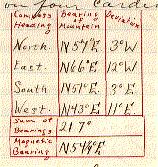
Stopping off the New York Ensign Farrant reported on board. When he returned we headed out into the Bay and swung ship for deviations on alternate points, swinging on a mountain about twenty five miles distant. After swinging ship, set course for Cebu.
7. The speed averages 8.5 knots, one knot more than before the new screw and reversing were put on. This still low speed is due to the small size of the boiler. The engines work well, but steam cannot be kept above 65 pounds.
[Page 111]
Sept. 8. At about 6 a.m. we swung ship again, to compensate. Swung on P. Bello Leyte, a mountain 45 miles distant.
Compensation of Compass.
Removed spheres and all correctors.
Swung on four cardinal points.
Headed ship East by compass.
Placed two magnets in upper tray, with red (N) ends aft.
Kept the azimuth circle pointed to the mountain.
Moved the tray up until the mountain bore N54oE, keeping the ship headed east by compass. That is, following the compass by the ship. With ship headed east by compass and mountain bearing N54oE, the deviation on East was zero. Upper tray at 26th notch from top.
Headed ship N by compass.
Placed two magnets in lower tray, red (N) ends to Port.
Moved the tray up, but the compass was not affected.
Put in four magnets, lower tray, red ends to Port, moved it up to 77th notch from top and deviation was zero.
Put on spheres and at outer limit, heading North East deviation was zero.
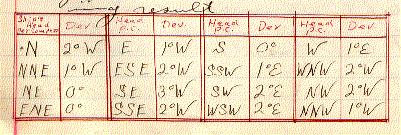
Swung for residual deviations with following result.
[Page 112]
At 4 p.m. anchored off Cebu, Cebu, between the U.S. Ships Pampanga and Leyte. The Isla de Cuba was senior ship, Commander Perry Garst.
9. At 6 a.m. went alongside the Iris and took 6-1/2 tons of coal, and fresh water. At nine oclock returned to our former anchorage. At 8:15 p.m. we got orders to start for Catbalogan, Samar at daylight next morning.