Previous Page | Next Page | Main Noa Page
Smyrna, Asia Minor
27. Anchored in the lower harbor of Smyrna - 6 p.m.
28. Moved close up to the city during the morning, saluting and paying official calls.
Smyrna is the largest city in Asia Minor, and next to Constantinople, the most important in Turkey. This city was famed in ancient times for its commerce and learning, and has taken a prominent part, from the time of the earliest records, in the history of Asia Minor, where numerous races have incessantly fought for power during all the past ages. It differs from other cities of historic and scenic interest, in that here, the antiquities and oriental relics merely flavor the modern life. The principal charm of the city consists in its crowds of busy people and the interesting shops, where foreigners buy as souvenirs
[Page 34]
what the natives use and actually wear. At Naples and Gibraltar are offered for sale articles made especially for Tourists and at proportionate prices.
The bulk of the inhabitants of Smyrna are Greek, and that is the language most commonly used. The streets are narrow, but clean, comparatively. It is very difficult to find your way about, and one often gets quite lost and turned round, forgetting even the proper direction to follow. It is said that robberies frequently occur, and everyone goes armed.
There is a hill Mount Pagus near the city on which stand the ruins of an ancient castle. from these walls, built of rubble,
[Page 36]
a most wonderful birdseye view of the city is seen. The houses all being low, the Mosques with their rounded domes are very prominent and make a picture, interesting because different from what one is used to.
The canon on Mount Pagus are old, smooth bore guns. The four battalions of a thousand men each stationed in Smyrna by the Turkish Government do not drill well, the officers can not handle such a large force, but the individual men are excellently disciplined. At the foot of Mount Pagus I was entertained by a Turkish lieutenant, at a small Casern, or Barraks. The squad was going through setting up drill and practising their “goose step” adopted from the German army. The energy and precision of the men could not be surpassed; the legs went up together, were held their [sic] in proper position and at the count came down with force. Their [sic] were two sentries stationed facing each other at the door. They stood like soldiers should, rigidly at attention, and when an officer passed between them, at an order from one the two came to present arms in a manner that would do credit to anyone. The “Salaam” or Turkish salute, practised as well by civilians paying respect to women as by soldiers consists in touching the waist in front with the hand, making a circle with the hand as it is brought to the visor of the cap, finishing as in our own salute. It is quite graceful and though it takes a long while it is better than the French salute where the palm of the hand is raised perpendicularly and the palm out.
There are a large number of English residents and other Europeans living in Smyrna, and a[t] Bournabat a suburb. At this latter place they live in palaces. and enjoy the greatest luxury, in a land where all is cheap, servants plenty and summer always.
[Page 50]
[i]
1900 Smyrna, Asia Minor
November 29 Thanksgiving day. The Turkish Commodore stationed at Smyrna visited the ship. Boat races by the crew.
Sat. December 1 Held a reception on board in honor of the american Consul Mr. Lane, and the people of Smyrna. The Captain, Lts Moffett and Scott and Ensign Palmer left for Constantinople on a visit to the Sultan.
7. The Greek Consul visited the ship and was saluted with nine guns.
Sun. 9. Dressed ship in honor of the Sultan’s
[ii]
birthday. At night threw the four search lights on the four flags at the mast heads and bow and stern of the ship. Ashore the occasion [sic] was celebrated by red lights and a few sky rockets.
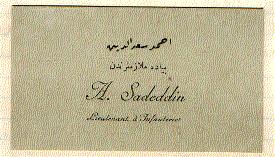
10. A reception at the Consulate attended by officers in uniform. I was visited by M. Chugri, Lieutenant in the Turkish army, and two captains. MM Chugri and Sadeddin I had met ashore. The officers came in uniform, with swords on.
11. Held another reception on board.
13. Captain Chester and party returned from Constantinople where they had been royally entertained by the Sultan, being invited to dine and private audiences with him. The presence of the Kentucky at Smyrna induced the Turkish government to pay the indemnity of $100,000 claimed by the United States for the murder of some American missionaries.
[iii]
The Sultan sent as a present, a small box of about 25 cigarettes and a box of pipe tobacco for each of the crew; and large boxes 200 cigarettes, and a pound of tobacco to each officer. The quality of the tobacco is rather poor, but the Sultans kindness is much appreciated. Last year an English fleet was presented with tobacco of the same kind and under similar circumstances.
[Page 52]
1900 Smyrna, Asia Minor
December 15 “At Home” on board the Kentucky. I took lunch at Bournabat.
Sun. 16 Received orders to proceed at once to Manilla. Up to this time we had expected and hoped for a longer stay in Smyrna, which in every way is a pleasant place for a ship to spend the winter.
17. At Sea, En route to Port Said
Got up anchor at 2:00 p.m., steaming for Port Said at ten knots with only boilers under steam.
18. Fine weather and pretty scenery. The same kind of islands that we passed near Greece. Sub calibre practise every day at sea.
20. Port Said, Egypt
Moored in the harbor at 9 a.m. No salute was fired, it being against the port regulations.
Port Said is the northern terminus of the Suez and Port Said Canal. A worse site for a city could not be imagined, but this place was the natural base of operations during the construction of the Canal previous to 1869, when 30,000 men were employed; and it is now necessary as a coaling and supply station for ships. Port Said has been called “The meanest city in the world; the sink-hole of three continents.” This might be true, but the place is almost too insignificant to deserve such a big title. It is a “mean” place without being a dangerous one. A statue of DeLesseps
[iv]
at the end of a breakwater at the canal entrance, a mile out to sea, is the only thing to admire. There is very little to buy and nothing to do.
21 Suez Canal.
Started through the canal at 6:45 a.m., 5 knots speed, with our own engines and towed by a tug to aid the steering; a pilot in charge. Large vessels cannot go straight enough without the aid of a tug, especially around the bends. As it was we touched the sides of the canal, grounded several times, and frequently being aground on one side, with the tug and our helm pointing the bows to mid stream we would run aground on the other side.
[Page 54]
[Map of Suez Canal]
The Isthmus of Suez is a complete desert. Its highest point is 56 feet above sea level, while many depressions are below the sea. The canal passes through two of these, which now filled up are called the Great and Small Bitter Lakes. The oasis of Isma[i]lia,
[v]
a small village is on another Lake at the middle of the Canal.
The canal is a tide water canal, a ditch between the Mediterranean and the Red Sea without locks or feeders. It is 87 miles long 325 ft wide at top, 72 feet at bottom and 28 feet deep. Constant dredging is necessary to keep it from filling. The currents are various and in different directions in
[Page 56]
different seasons. At intervals along the canal are signal stations which direct which vessels shall haul into the “sidings”, wide, deep places, in order to let other vessels pass. Mail steamers are given the right of way over man-of-war and merchantman alike. Every hundred and fifty feet along both sides of the canal is a bollard to which a ship may tie up in rough weather--sand storms--or to enable her to haul out bow or stern when aground. The bottom is soft sand so that groundings are never serious.
At 8:25 we anchored for the night at Ismailia.
22. Six officers left the ship for a few days at Cairo, joining the ship later at Suez. We anchored at Port Tewfik,
[vi]
southern terminus of canal at 6 p.m., and saluted Egypt. Suez is two miles from the canal; very large ships, and all those in a hurry do not go up to the town.
23. Suez, Egypt.
The Suez Canal cost a hundred million dollars to build. England owns nearly two hundred thousand shares and controls the canal, but by the treaty which declared it free from fortification and blockade, it is left under the management of the French. The charges for passing through are calculated by tonnage by measurement. The Kentucky paid for tonnage $7871, for towage $1749, pilot $19.50; total $9620.
25. Suez has lost by the canal instead of gaining. Formerly the East Indiamen brought their cargoes to Suez to ship by caravan to Alexandria. Now the ships pass through by Port Tewfik, and Suez gains but little by it. When Suez was in its prime its water supply was brought by ship from the Arabian coast. Now, however, a fresh water canal connects it with the Nile. The city has no more attractions than Port Said, except for a few hours one can look at the houses which differ slightly from those at other places. Well built they seem from the out-
[Page 57]
side, but within a single room, mud floors and a pile of wood in the corner for a stove. The children wear a single garment like a nightgown, and of every color and pattern, so that a group of them playing ball looks like a cheap chromo with plenty of colors but no other artistic merit.
[Map of “Canal Maritime de Suez”]
[Page 58]
[vii]
December 26 Suez, Egypt.
The natives coaled our ship. They are Arabs who come, under their Sheiks, by contract with the coal companies. They pass the coal up stages in wicker baskets, singing as they work. There is no limit to the speed with which a ship can coal if the bunkers could be stowed, but an equal number of Arabs, by their method, do not coal as fast as our own men with big canvass bags and booms and winches.
27. Red Sea. Suez to Aden.
Started for Aden at 12:40 p.m.
28 Subcalibre practice; full charges in 5” & 8” guns.
31. At midnight the crew announced the new century with long blasts of siren and whistle, the band played, and 750 men with tin pans, bugles, boxes and everything capable of being beat on raised more noise than the Red or any other sea of any color had ever heard before. The buglers did more than their share, and called general quarters and collision and away boots for full half an hour. A tin kettle company paraded the wardroom and even visited the cabin; but the captain was on the bridge.
[i]
In margin: “Very good. C.M.Chester, Capt Comdg”
[ii]
Abdul-Hamid II, Sultan from 1876 to 1909. The Armenian persecutions occurred under his reign.
[iii]
The missionaries were killed during the Armenian persecutions. There was a long-going dispute between the US and the Sultan about reparations, which were ultimately resolved by the Sultan purchasing a warship from the US for £320,000, of which £23,000 were unofficially for reparations. The USS Kentucky was sent to Smyrna to prod the process along, as well as to further discussions between the two nations about a US embassy in the sultanate. Great Britain and Germany were also pressing for reparation payments.
[iv]
Vicomte Ferdinand Marie de Lesseps (1805-1894), promoter of the Suez Canal.
[v]
“Founded in 1863 as headquarters for building operations on the canal; named for Ismail Pasha.” (W.G.D.)
[vi] Now Port Taufiq.