THE HISTORY OF THE USS NOA DD-343 IN WWII
Beachwood Blvd.
Beachwood, N.J.
November 28, 1945
Dear Mr. Morehead,
Enclosed is a copy of the "history" of the USS Noa, named after your uncle, I believe. I hope the copy is legible enough for you to read.
You will note that I put the word "history" in quotes. Understand that this thing was written for the "amusement and amazement" of the crew of the Noa when we were far out in the Pacific and had been for quite some time. I wrote it pretty much for the purpose of boosting their morale, as the Noa, by that time, was getting pretty decrepit and I could see the boys were a bit envious of the soft lot in life led by the boys on the modern destroyers.
One thing an old destroyer had that a new one didn't was background, of which the Noa certainly had her share. In the Navy though, stories get handed down over a long period of time so that it eventually winds up with all the earmarks of truth with no simple way of checking it. However the incidents from July 1941 on that happened aboard the Noa I can vouch for myself.
I believe I am the authority on the old Noa, certainly in this war. It was the only ship I served on and of the 3-1/4 years aboard, I was skipper the last year and a quarter, the "glorious" part of her career. If you are interested further, I'd be glad to answer any questions you might have or to have you call on me any time. Beachwood is on the Atlantic City-New York highway a mile south of Toms River. Our house is on the NW corner of Beachwood Blvd and Forepeak Av, two blocks from the highway.
Yours very truly,
H. W. Boud
================
SHORT HISTORY OF THE USS NOA (DD343 & AFD-24)
(From memory and unsubstantiated scuttlebutt)
N.B.—This was written originally in the summer of 1944 for the edification of the crew of the Noa only.
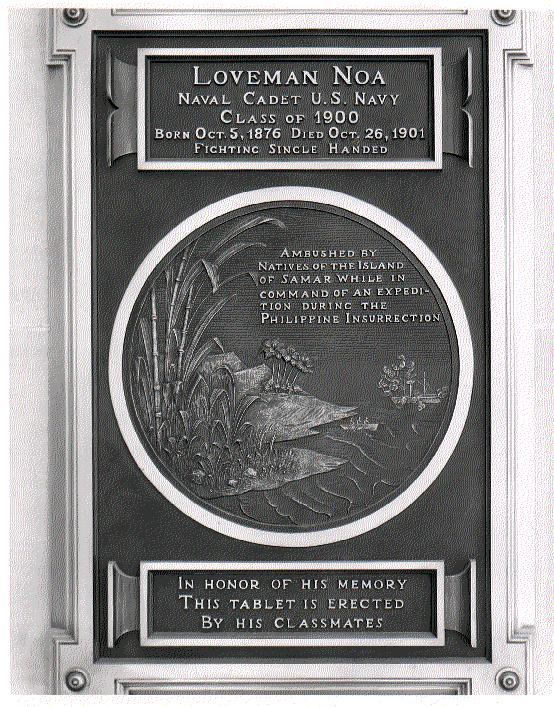
The Noa is named after a midshipman who was killed while leading a landing party against some head-hunters in the Philippines. The Noa is famous amongst old-timers in the Navy as being the savior of a white colony far up the Yangtze River. Some Chinese bandits were on the loose and Captain Sims (?) of the Noa (son of an admiral) on his own responsibility, opened fire on them and held them off until the entire white settlement was aboard, then made his way down the river.
The captain feared this would cause an "international incident" and that he would get a general court martial out of it. It preyed on his mind until he finally committed suicide. He was awarded the Navy Cross posthumously. This was in the 1980s, I believe.
The Noa also went aground in the Yangtze River and was pulled off by a tug, a member of whose crew was the same Commander Genereaux who pulled us off in Noumea.
Also while on the Asiatic Station some "doughhead snipe" turned the wrong valve in a rapidly whirling turbine of a generator and the whole business exploded, killing and wounding several bystanders. Presumably this was before they had safety valves on generator turbines and may have been the cause for installing the same.
The Noa is also one of the three "pig iron" boats, meaning, the Noa and two other 1200-tonners, unlike the rest, have ungalvanized deck-plating. There are two stories on this—which is correct, not known. One is that the deck had to be renewed in China and there was no galvanized plating available. The other, that the Noa, being one of the last of the World War I ships to be built (commissioned 1921), "scraps" were used in her construction. She was built in the Norfolk Navy Yard and there are men still there who helped build her.
The Noa was decommissioned about 1934 in the Philadelphia Navy Yard. She lay in "red-lead row" for years and was finally recommissioned on 1 April (April Fool's Day) 1940. Lt(jg) Dutch Schwaner was the officer who was largely responsible for putting her together again. He figured he was going to be Engineering Officer and concentrated on that department, but when she was recommissioned they made him First Luff [First Lieutennt] and Gunnery Officer. The so-called "plank-owners" who are still aboard are McDaniels, W.E., CMM (then MM1c); Richards, J.H., MM1c (then WT2c) and Josephi, N., SClc (then S1c).
The Noa had some indeterminate duty at the mouth of the Delaware River at first — probably a sort of shakedown.
She was on "neutrality patrol" for a while and had her introduction to Key West, Florida.
An airplane was put aboard for experimental purposes and the Noa was fitted with a cruiser-type mainmast as a kingpost and a heavy boom with outriggers and winches for handling the plane. Our first plane sank on a trial trip and the captain, who was a passenger at the time, reported aboard in a seaman's uniform. A method was developed whereby we could lower the plane into the water and launch it at fifteen knots. We picked the plane up usually at a somewhat slower speed. From constant practice we became very adept at this, but in any kind of rough water it was not practical. For one thing, our ship was too small to make any kind of a slick for the plane to land in. As a result of the experiments, largely conducted inside the Chesapeake Bay, several 2100-tonners were fitted with catapults and planes in place of the #4 turret. The ship designers came aboard the Noa for advice. We were known then as the "Flying Tin Can", the only plane-carrying destroyer in the world and received correspondence from Buair as an "aircraft carrier".
The Noa was stationed at the Naval Academy at Annapolis, Md., for practically all of the year 1941. Our primary mission while there was to take the midshipmen out on three- or four-hour cruises to give them a little practical instruction. We always launched and picked up the plane as a demonstration. We also took out officers attending the Naval Intelligence School at Washington, DC. Many of these officers were ex-newspaper men, etc., who had never been aboard a man-of-war before boarding the Noa.
One of the difficulties in being stationed at Annapolis was that hundreds of visitors to the Naval Academy would look us over every week and we had to keep a very pretty ship — by order of the Admiral, the Superintendent of the Naval Academy. However, there was running fresh water, telephone service and electrical connections to the dock. Moreover, we seldom got underway before 0900 or pulled in after 1700. About once every two weeks we would go up to Baltimore to fuel.
In the spring of 1941 the Noa had an overhaul at the Baltimore Drydock Co., a private shipyard. This accounts for many of the non-standard alterations found about the ship. Mr. Brandt came aboard while she was here. Your present skipper came aboard in July of 1941 when she was at Annapolis.
The skipper at that time was Lt. Comdr. Mac N. Arison, an ex-submariner, and incidentally, an old math prof when I was at the Academy. He was navigator of the San Francisco when she tangled with the Jap battleships off Guadalcanal and in the same explosion that killed Admiral Callaghan and Captain Cassin Young, he was blown from the bridge and wrapped around a 5-inch gun. Lt. Comdr. Bruce McCandless took over and became a national hero — actually our "Captain" Arison was the senior survivor of that disaster, but of course, was in no condition to take over himself.
During our stay at the Norfolk Navy Yard in this Annapolis period, we had the first underwater-sound dome ([?]6000) in the US Navy put on. In order to have our bow in the correct position, they had to back us into the drydock. After this we made a trip to New London, Conn., to perform underwater-sound experiments in company with other experimental underwater-sound ships. As a result of these experiments it was determined that the Noa's gear was the best. In our return to Annapolis we made the passage on the inland waterway from the south of the Delaware to the head of the Chesapeake. On this route we had the unusual experience of traveling at ten knots with land a few feet on each side of us towering higher than the mast.
Subsequent to this we escorted the (first) carrier Hornet on her builders trials. An unusual experience on this trip happened when the Noa was making flank speed trying to catch up to the Hornet — just as we were drawing abreast of her she backed down emergency full and was going over 25 knots in the other direction so quickly that we overshot about five miles before we could get turned around to resume the chase.
The Noa was at Annapolis long enough for everyone to get well "situated" and there was much moaning and gnashing of teeth when we pulled away from the Santee dock to go to Boston for an overhaul. The Lt. Cdr. Bosque N. Wev had relieved Captain Arison just prior to this time. We went to Boston through the Cape Cod Canal and while there our after searchlight was removed and several 50-cal. mg's added. Our AA armament consisted of 4-50 cal. mg's and our submarine weapons were the short racks of 300 pound depth charges.
War was declared. December 9th there was a very realistic air alert throughout the East. The Noa's plane, a scout-observation biplane of about 70 knots speed, possessing one fixed and one free 30-cal. mg was the only armed plane in the air to "protect" Boston. Shortly thereafter, while enroute to Norfolk and after having picked up our plane at sea in a blinding snowstorm, the Noa made the first anti-submarine attack of the war off the East Coast. It was off Block Island, the night of December 12th. Captain Wev claimed to have seen a torpedo wake. A merchant ship in the vicinity reported having been chased by a sub. We believe we drew a little oil.
On our arrival at Norfolk we were greeted by a bevy of officials inquiring about this first attack. (Storekeepers note — those depth charges were title B and had to be formally surveyed.) A few days later we took the Hornet on her post-repair trials. The second day out we obtained a sound contact on what we later determined was a sand bank, but the Hornet had long since disappeared over the horizon, having made tracks on our first contact. About ten o'clock that night we came across her again, safely anchored about halfway up the Chesapeake, off Wolf Trap Light.
The day before Christmas 1941 the Noa took aboard a group of about twenty "boots", amongst whom were Bailey SM1c[1], Goodwin QM1c[2], Milburn BM1c[3] and Cleveland GM2c[4].
The day after Christmas we went out as part of the screen on the shakedown cruise of the Washington, North Carolina and Hornet. At this time the skipper of the Hornet was the same Captain Mitscher who is at present Commander Task Force 58, the task force which recently turned back the Jap fleet.
The Noa, with her plane-handling gear, was specifically assigned to both screen and act as plane-guard for the Hornet. There were no other screening vessels. Through January 1942 we steamed in the Gulf of Mexico, occasionally making fast trips into Key West for fuel. Once we went into Pensacola and twice we fueled from the Hornet. On one occasion while steaming alone at night we had the uncomfortable experience of suddenly being illuminated by the North Carolina searchlights with her entire main battery of 16-inch guns trained on us, before captain Wev found out who it was he had threatened to torpedo the "culprit". We were privileged to witness the first long-range gunnery exercises held between the Washington and North Carolina.
At the conclusion of the shakedown, the task force headed north around the tip of Florida at high speeds. Due to heavy weather the Noa's bridge was bashed in and at one time there was four feet of water in the pilot house, throwing the helmsman on top of Captain Wev. The Noa had to pull out of the formation and made her way at slower speed to Charleston, N.C., for emergency repairs.
While at Charleston the USS McKean, APD-5[5], came alongside us. Then the Noa and the USS Dahlgren escorted a transport to Bermuda. Off Bermuda we were to detached and proceeded directly to Boston. Enroute in passing out of the Gulf Stream the temperature dropped 40° (water) in about two minutes.
While at Boston this time our plane was removed and K-guns, 20mm guns, new main generators, permanent degaussing coils fibre glass were installed and the bridge was inclosed.
We left Boston as escort for a lightship enroute for Casco Bay, Maine. The first night out, due to heavy weather and having to close the lightship for megaphone communication, we collided and both of us returned to Boston for emergency repairs. At this time the Noa received a new bow section. We also were docked in the largest drydock in the U.S. This was necessary as it was the only drydock then available which could be used to fit us with a new "tilting head" sound projector. This dock had taken the Queen Elizabeth and could easily have taken ten of the Noa.
We were then assigned to Commander Eastern Sea Frontier and operated out of Tompkinsville, Staten Island, on submarine hunts and rescue missions. Our first job was to search for survivors of the SS Carolyn, which had gone down in flames three days out on her first cruise. The Carolyn was the sister ship to the Evelyn, on which our own Lt. Schwaner was then stationed.
Our scene of operations shifted to Norfolk and we worked with the USS Herbert, now APD-22, in submarine hunting between the Delaware River and Cape Hatteras. At this time submarine activity in this area was at its peak. "Floaters", dead bodies floating around in the water, were a common sight and seldom were we out of sight of a burning tanker. One small area of Cape Hatteras was a regular graveyard of sunken ships. We called this “torpedo junction” long before the name was given to any other areas and I doubt that there is anywhere else such a concentration of sunken ships. It was in this vicinity, more specifically near Wimble Shoals Buoy, that the Noa and Herbert made their first “kill”. Between us we dropped nearly a hundred depth charges on her and watched air bubbles rise from her for the next two days. The Navy Department sent out a salvage tug but due to rough weather were unable to send down a diver.
It was during this period that we made our first contact with the Manley, APD-1. She picked up over a hundred survivors from a torpedoed ship in the vicinity. One tanker burned violently for at least eight days before sinking. The Noa and Herbert were the first ships to escort coastal convoys on the East Coast. It was in this particularly bad area and for the first few days they tried to have us pick up scattered ships at sea and form convoys until they found the futility of this method.
Then we were sent to Key West, Florida and attached to the Fleet Sound School there. By this time the German submarine activity had spread to this area and we spent the better part of the next few months operating off the North Coast of Cuba and the East Coast of Florida on submarine hunts. North of Miami there is another ship-graveyard. One night we sighted a submarine on the surface and the activity on the Noa immediately subsequent to this sighting is a story in itself. Suffice it to say that the submarine was crash-diving when we saw it and got away with only slight damage.
We were immediately thereafter extremely "trigger-happy" and went so far as to attempt to open fire on a patrol vessel which came between us and our convoy at dawn. Fortunately the first 4" shell used was a dud and by the time we replaced it, we were able to make out that the craft was friendly. Enroute to join up with one convoy one of our firecontrolmen accidentally fired one of our "ready" torpedoes while testing the circuit! Fortunately nothing was in the way. Another time an army bomber mistook us for a submarine and dropped depth bombs close aboard our fantail and covered the after part of the ship with water.
One German submarine surfaced within fifty miles of Key West and fired over sixty-five rounds into the hull of a Honduran fruit ship, leaving it abandoned in flames. The reason they could do this was that we had negligible air coverage of the area of the sea lanes at that time. The Noa in company with the PC-451 and two Navy PBY's[6] obtained her second "kill" at this time. It was west of Key West in the vicinity of Rebecca Shoals and the PC-451 obtained the first hit with the then-new contact anti-submarine bomb.
On one occasion the Noa was responsible for the salvage [of] a very large and valuable oil tanker. She had been torpedoed, abandoned and left burning. Investigating planes and ships had termed her unsalvageable but the Noa, happening by the following day, noticed that the fire seemed confined to one section and recommended her salvage, and she was.
We carried 21-million pesos (value over 21-million dollars) from Miami to Havana. This consisted of over two hundred bags of registered mail which we stored in our forward fire room. One sailor said, “I never realized handling money could be such hard work” as he lugged the heavy sacks across the dock. Our one night in Havana was probably the high spot of our entire stay in the area.
Enroute to New Orleans and the Todd-Johnson shipyards we made a half-hearted submarine attack on a mediocre sound-contact and two months later learned that we had seriously damaged a German U-boat as evidenced by his surfacing on two successive nights thereafter and broadcasting to Berlin a list of his damages and the fact that he was forced to return to base. We had been the only ones to drop depth charges in that area that day so it must have been us.
While lying-to off the mouth of the Mississippi we noticed two large explosions on the jetty. Upon our arrival at New Orleans, 120 miles up the river, we were immediately boarded by two army officers who wanted to know what our big idea was plastering their brand new jetty with torpedoes. We realized then, that unbeknown to us we must have been a sitting target for some enterprising sub. Our three nights in New Orleans were a pleasant change. Enroute down the river at night a heavy squall set in and we were forced to anchor in the middle of the river where we could see neither bank.
The Overton, Roper and Dickerson, now all APD's, frequently came into Key West at this time. On one of our trips a transport loaded with troops broke down a few miles from where a submarine had been sighted. On another trip tankers were sunk just ahead and behind our convoy of tankers and ours went untouched. At this time Key West had a large convoy anchorage accommodating hundreds of ships. The Sturtevant was sunk by an "underwater explosion" while making a submarine attack in this area. The Executive Officer had the presence of mind to set all depth charges on "safe" before leaving the ship, which consisted of stepping into a whaleboat alongside from the deck of the many of the ship which was already under water.
We began to get patrol plane coverage after this and submarine activity decreased considerably but we still were called out at night fairly frequently to chase down a sub which a plane had spotted but had not sunk. Such places as Bahia Honda, the Yucatan Peninsula, Cabo San Antonio, Cay Sal Bank, Nicholas Channel, the Florida Straits and the loom [?] of Havana became familiar sights to us. A blimp was shot down by a sub and it was this incident which gave us a clue and enabled us to put the finger on a two-bit spy which our ONI[7] finally nabbed.
The U.S. submarine E-12 sank mysteriously at this time and it was the Noa which provided the accurate buoyage which assisted in her location. The Noa was frequently the target for Sound School submarines in their torpedo practices and we thus obtained much valuable experience in detecting submarines at periscope depth and in avoiding torpedoes. On another occasion we fired one of our torpedoes in a practice with the Dahlgren and the thing shot off at a bum angle and chased an unsuspecting PC-boat for miles, finally passing it close aboard. Fortunately only the PC's feelings were hurt.
Captain Allen and Captain McGrath were skippers at this time and the following officers came aboard: Ensigns Polanski, Robinson, Young and Williams.
In July '42 we left Key West and proceeded to Norfolk to be converted to an APD. While there practically everyone aboard obtained some leave — the first and last for a considerable time. The main features of the conversion were the removal of two boilers and torpedo tubes and the addition of troop facilities, boats and radar gear. While there Ensign Margrave and the boat crews reported aboard.
We had a ten-day shakedown in the Chesapeake involving a trip to Annapolis where we tied up alongside our old, familiar Santee dock and had Mrs. Arison and her family and Mrs. Coventry aboard to see that the old-girl hadn't changed so very much. We anchored off Solomon Island, Maryland several times.
October 18, 1943 we left Norfolk enroute to Pearl Harbor to report for duty to Cincpac[8], Admiral Nimitz. We had one night in Cristobal, three nights in San Diego and three nights in Pearl Harbor. We were routed quickly onward; had a few hours in Pago Pago, Tutuilla, American Samoa, one night in Espiritu Santo, New Hebrides, one night in Milner Bay, New Guinea. Two days thereafter we were patrolling off Fischaven —from Norfolk, Virginia, to our then furthest point of advance in the Pacific without delay, total elapsed time fifty days including being slowed down by sluggish convoys throughout. "No more polywogs".
The day after Christmas 1943 we took part in the landings at Cape Gloucester, New Britain, 250 miles west of Rabaul. Our first landing started out rather inauspiciously as we were required to tow a YMS[9] most of the way. Also about three hours prior to H-hour our Charley Noble caught fire, giving forth a monstrous glow against the black night for several hectic minutes. The landing came off well enough though one of our boats became hung up and we had to leave it and the crew including the boat officer there while we went back for reinforcements. Both the boat officer and the ship received commendations out of the landings. We had left the area just prior to the Jap air attack which sank one of our new 2100-ton destroyers. Our reinforcement trip was uneventful.
The day after New Years 1944 we made the landings at Saidor, New Guinea. On our previous landing we had carried the First Marines. This time we carried the Army. On a return from this landing Transport Division 16, of which we were a part, was ordered to Sydney, Australia, for a bit of rest and recreation. At the last minute the Noa was eliminated and instead we got to go to Noumea, New Caledonia.
Shortly after arriving at Noumea and just long enough for us to get our engineering plant torn down for repairs, a tropical hurricane sprang up and the tender-nest, of which we were a part, was broken up and the Noa was blown aground. Incident to this, a PC-boat was blown broadside across our very sharp bow and we nearly cut her in two. Our “rest” in Noumea was consequently very much curtailed.
The first of February 1944 we reported in to Guadalcanal and anchored in Purvis Bay near Tulagi, Florida Island. We picked up some New Zealanders at Vella La Vella having escorted some LST's[10] to Munda, New Georgia, enroute. Then we took part in the landings at Green Islands, 120 miles east of Nabaul. We got underway for this trip with a load of New Zealanders on Saint Valentine's Day. We were besieged by Jap snipers on the way up for our first close contact with the enemy planes. At the landings itself we underwent our first air attack though the APD's were never the Jap targets.
We returned to Hawthorne Sound, which is between Kolombangars Island and Rice Anchorage on the Kula Gulf, scene of the Helena and many other disasters. We picked up more men in Vella and made a second echelon landing at Green. After that we made a short escort trip to the Russels, anchoring for two nights in Tillotsen Sound off Renard Sound.
On St. Patrick's Day we got underway with Fourth Marines aboard for the landings at Emirau Island, a few miles north of Kavieng, New Ireland. This was our first landing with carrier-plane coverage. Nearby Kavieng was also being plastered by our battleships and cruisers at the same time. We were then ordered to proceed to Milne Bay again and this time took aboard as passengers a group of native coast-watchers, men, women and children. They proved to be better behaved than any other passengers we ever had.
We had a rehearsal on the Lao landing beaches then preceded with the largest force we had ever been with to the landings at Hollandia and Aitape. in addition to the army troops we carried, the Noa took part in the pre-H-hour bombardment, bombarding one of the small islands off the beaches.
The following day we returned to the same area and made a landing on Seleo Island. We bombarded Seleo and in this connection had some interesting moments. A destroyer whistled her bombardment shell uncomfortably astern of us forcing us to move to another position for our own bombardment. This involved passing between two reefs so that at one time there were breakers curling over the reef edges just a few yards on each side of us. We had hardly gotten into our new position when the cruiser Nashville dropped a 6" salvo short of her area and about a hundred yards off our port quarter. The splashes from this near catastrophe had hardly subsided when one of our dive bombers let go his bomb too soon and it landed with a “thwack” and terrific concussion just off our port bow.
Fortunately “cease firing” was ordered at that time and we returned through the reefs to provide cover for the assault waves as they moved in to the beaches. We were fairly close to and off to one side of our boats as they hit the beach and were thus able, for the first time, to get a really good angle view of the troops as they hit the beach.
Subsequently we picked up troops at Saidor and were thus able to witness the development of an area we had helped to occupy.
We were ordered back to Pearl Harbor, making the trip all the way in company with the Kane, and stopping by Funa Futi in the Ellice Group. We almost ran aground a “floating" sandbar enroute. We picked up a contingent of the Second Marines at Napuna Bay on the Island of Hawaii and proceeded to the Saipan landings. It was decided not to land our troops on D-1 night via rubber boats as originally scheduled and instead we landed them on already secured beaches on D plus 1 day.
In screening the USS Louisville at Magicienne Bay, Saipan, we were unconscious of danger from three sources. Shortly after we left her the Louisville underwent an air attack and also passed close aboard a floating mine. A few days later we learned that the Japs still had guns in the caves along the north northern coast of Tinian where we had paused so curiously close.
The first week or so after the initial landing at Saipan there were regular evening air attacks by the Nips but none of their bombs came too close to the Noa.
On the night of 5-6 July the Noa, while carrying out a harassing bombardment of Tinian Town and the southern tip of Tinian Island, underwent her first real test of fire. While steaming at slow speed less than two miles off the coast, as we had seen others do in other areas, we suddenly had shells whistling overhead and splashing with loud, flashing detonations all around us. We quickly wriggled out of there and for the remainder of the night, though the Japs shore battery continued to fire at us, they never again straddled us. It has since been discovered that they had three 6" guns hidden in caves at the southern edge of the town. This same battery killed 98 and wounded 140 in a horrible three minutes on the Colorado a few weeks later. Though they harassed us, which was not on the schedule, we set fire to two large cane fields and certainly harassed them with our high-explosives going off in their town all night long.
After this we were in the Guam invasion (Third Marines) but only as a Screening vessel. On our return from Guam to Espiritu Santo our engineering plant broke down 31 times in 24 hours and we spent most of our time, when we weren't wallowing helplessly, in chasing the convoy we were supposed to be leading. This was the climax of the long series of engineering casualties brought on by trying to keep these World War I ships operating continuously. We had steamed five times as long without overhaul as we would be allowed to do in peacetime.
From here we returned to Purvis Bay via the Russels, picking up two ensigns, Herndon and Francis, and 42 bags of mail enroute. Most of the mail was Christmas packages — just eight months overdue — or 10 months enroute. At Purvis we prepared for what proved to be the Noa's last trip, the invasion of Peleliu Island in the Paulaus. We took aboard Underwater Demolition Team Able (seabees) with their supplies which included nine rubber boats and 50 tons of tetrytol, a high explosive.
At 0451L on 12 September 1944 (D-3) day the old Noa finally met her Waterloo in the shape of an American 2100-ton destroyer, the Pullam, DD474. In the predawn maneuvering preparatory to commencing the initial bombardment of Peleliu and Anguar Islands, two of the battleship-cruiser groups with their escort tangled with each other and in the ensuing confusion the Noa and the Pullam had collided. She hit us a glancing blow on the afterboard side of the after-engineroom, just about ten feet forward of that fifty tons of high explosive. She pulled our starboard screw and about forty feet of shaft along with it – caught in her bow. We flooded aft fairly rapidly and the stern was underwater in a few minutes. The ship was abandoned in good order considering the darkness and the suddenness of the catastrophe. The rubber boats came in handy for those of us who were last to leave the ship. Though a few men were thrown in the water by the jar of the collision, no casualties were suffered.
Ceravolo, GMSc, went back on the fantail and checked the depth charges in the racks for safe setting. This was dangerous as it was dark, the decks were wet and slippery with fuel oil and also the ship was going down by the stern rapidly at this time. Despite these precautions one or more of them must have gone off when the ship sank for about six minutes after the ship had nosed up and slid beneath the surface there was a terrific detonation, just as though the depth charges as well as the tetrytol had exploded.
When it became light and we had determined by muster on the Pullam that all were accounted for, we formed a salvage party to return to the Noa to see what we could do to keep her afloat. In trying to light off her dry boilers, only the actual rumbling of the tortured drums stopped us. Ensign Francis, who had been aboard only 25 days, deserves a lot of credit for this task for he carried out my orders despite his full realization of the danger involved.
We tried just about everything and one by one our small means of saving the ship gave out. We ran out of acetylene and oxygen for burning off topside weight. The gasoline handy-billy pumps ran out of gas. The ship kept settling deeper and deeper so that we could no longer enter compartments only partially flooded since water pouring down the open hatch would fill them faster than we could pump them. Just as it seemed we were going to be able to get up steam, with the water lapping around the fire room patches, the ship lost its remaining buoyancy, became logy, and again we abandoned ship.
About five minutes later the Noa pointed her bow straight up and, with a great hissing of air coming out of her forward hatches, sank in thousands of fathoms of water — west of Peleliu and, incidentally, west of the latitude of Tokio. It had been a heartbreaking attempt at salvage and the salvage party circling her in landing boats all had extremely moist eyes as they watched her disappear.
An aftermath of the Noa's sinking was a General Court Martial held in San Francisco. The Noa's skipper was cleared on all counts. In this trial coincidence, which seemed to play such a large part of the Noa's history, again made its appearance. The President of the Court Martial had been a classmate of Midshipman Noa and another member of the court had been a shipmate of Midshipmen Noa at the time he was killed in the Philippines.
Both he and she died with their boots on.
N. W. Boud
Lt. Comdr., USNR
(Last commanding officer, USS Noa)
APD-24 ex DD343
==============
December 6, 1945
Lt. Commander H. W. Boud
Beachwood Boulevard
Beachwood, N. J.
Dear Commander Boud:
It was very kind of you to send me the history of the Noa, and I am sincerely grateful. My aunt, Mrs. Samuel Davis, will be positively delighted; she is out of town this week, but will be back next week and I am sure she will write to you.
I was on the old Noa three or four times, but before your tenure. We grieved when she went down, and didn't know about the new one until we read about it in the paper. However, we went to the commissioning of the new one at Charlestown on November 2, and enjoyed it thoroughly.
One of our greatest ambitions (like most people's) is to get an automobile, and if and when we do I am sure we will take advantage of your kind offer to come in to see you. Until then, it probably won't be possible. I hope that if you are in New York you will let us know.
Thanks again for your thoughtfulness.
Yours sincerely,
[Albert H. Morehead]